

One of the most common risk mitigation tools in the construction industry is subcontractor bonding. As a general contractor, requiring your subcontractors to “bond back” can reduce financial risk, improve project oversight, increase bonding capacity, strengthen owner confidence, and help you compete for larger projects.
Read on to learn how subcontractor bonding works and when to utilize this strategy.
What is a subcontractor bond?
A subcontractor bond is a type of construction surety bond that protects a general contractor if a subcontractor fails to meet the terms of their contract. In most cases, a subcontractor bond refers to a performance bond, payment bond, or a combination of both.
General contractors often require subcontractors to obtain these bonds—a practice commonly called “bonding back.” If a bonded subcontractor defaults on the job, fails to complete its work, or doesn’t pay suppliers and lower-tier subcontractors, the surety may step in to help resolve the situation, reducing financial risk for the general contractor.
Subcontractor bonds are especially common on larger commercial, industrial, and public construction projects where delays or subcontractor defaults can have significant financial consequences.
What is subcontractor bonding?
Subcontractor bonding typically occurs when a general contractor requires a sub to “bond back.” This is the most used risk mitigation tool in the construction industry – for good reason! As a GC, you depend on your subcontractors to do the work they’re hired for to your standards. Requiring construction bonds from subs working under you can mitigate risk on jobs, ensuring projects are completed as planned.
If a bonded subcontractor defaults on a project or something unpredictable happens, a surety company can recover the losses or find a substitute contractor to finish the job.
How does bonding back work?
At a basic level, bonding back is a way to guarantee your subcontractor’s work and their ability to pay their suppliers and subcontractors. Requiring bonds holds subs accountable and helps avoid project failure.
If your sub is bonded and they fail to fulfill their contract, you can file a claim on the bond for any money you lost on the project. The surety has a number of solutions they can use to get the project back on track.
Subcontractor bonds include various types of construction bonds. These are the most common, typically issued simultaneously:
- Performance bonds ensure a project is completed according to the contract.
- Payment bonds ensure a subcontractor pays its suppliers and vendors as promised.
The Typical Bonding Back Process (5 Steps)
The process usually works like this:
- A general contractor awards work to a subcontractor.
- The subcontract requires the subcontractor to obtain performance and payment bonds.
- The subcontractor applies for bonding through a surety.
- If approved, the surety issues the required bonds.
- If the subcontractor defaults or fails to meet its contractual obligations, the general contractor may file a claim with the surety.
This process gives general contractors an additional layer of protection while helping keep projects moving if unexpected problems arise.
What types of subcontractor bonds are there?
As we mentioned above, most subcontractor bonding involves one or both of the following bond types:
Performance Bond
A subcontractor performance bond guarantees that the subcontractor will complete its work according to the subcontract agreement. If the subcontractor defaults, the surety may finance completion, arrange for another contractor to finish the work, or otherwise satisfy its obligations under the bond.
Payment Bond
A subcontractor payment bond guarantees payment to suppliers, laborers, and lower-tier subcontractors. This helps reduce the risk of payment disputes and potential liens on the project.
Although performance and payment bonds are the most common subcontractor bonds, some projects may also require additional bond types depending on the contract.
What are the benefits of subcontractor bonding?
Subcontractor bonding can be a shrewd strategy for contractors. Here are some of the top benefits of requiring your subs to bond back.
1. Mitigate Risk
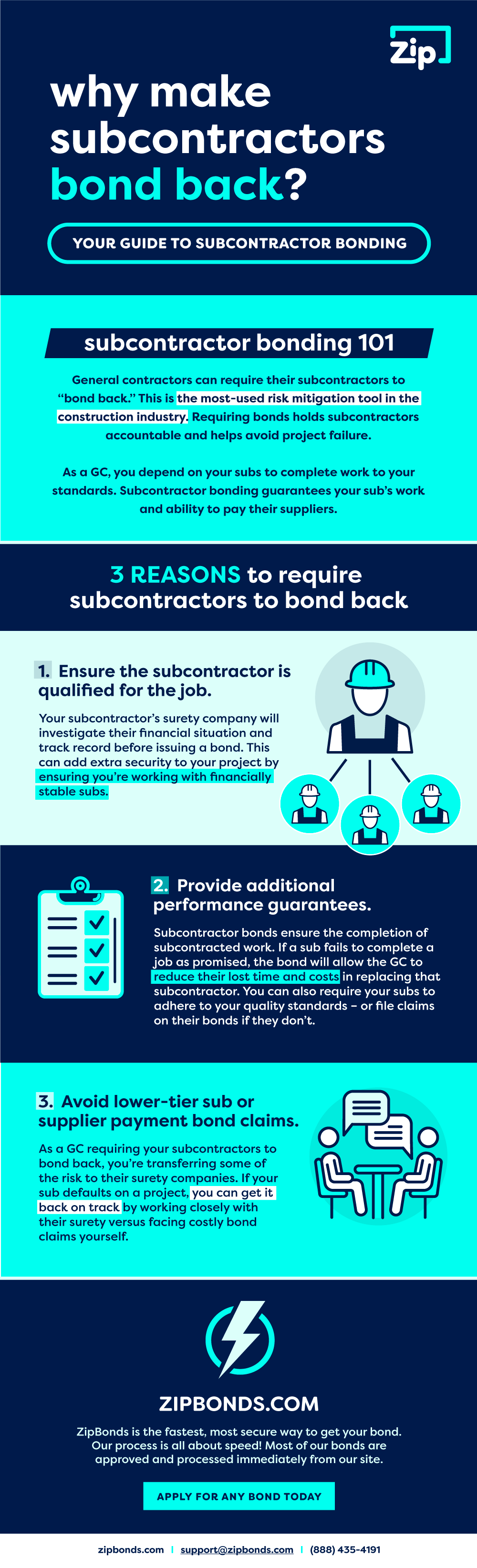
As a GC requiring your subs to bond back, you’re transferring some of the risk to their surety companies. If your sub defaults on a project, you can get it back on track by working closely with their surety.
2. Ensure Quality
Your sub’s surety company will investigate their financial situation and track record before issuing a bond. This can add extra security to your project by ensuring you’re working with financially stable subcontractors. You can also require your subs to adhere to your quality standards – or file claims on their bonds if they don’t.
3. Complete Projects
Subcontractor bonds ensure the completion of subcontracted work. If a sub fails to complete a job as promised, the bond will allow the GC to reduce their lost time and costs in replacing that subcontractor.
4. Win Larger Jobs
Contractors can increase their bonding capacity by bonding back subcontractors. If your bonding capacity is 2 million, for example, you may be able to bid on a $2.5 million job if you require all subs with trades over a certain amount to be bonded. This splits the risk among different sureties.
While the main contractor will be responsible for the entire project, they can recoup potential losses from their subs’ sureties if needed, rather than placing all the risk on one surety. Requiring subs to bond back can be a shrewd strategy for hard-to-place contract bonds.
5. Enhance Your Reputation
Bonds represent financial stability and the promise to fulfill a contract. If both the GC and the sub are bonded, project owners will have more peace of mind.
6. Protect Yourself from Unforeseen Events
The bond will cover potential losses if something unexpected happens, such as a sub getting too sick to work or a project getting shut down. If a subcontractor causes a delay, adds labor expenses to the project, or material costs increase, the subcontractor’s surety will be liable for covering the added costs.
Is subcontractor bonding worth the cost for contractors?
A common concern for general contractors is the added cost to the bid and overall project when they require subs to bond back. The subs, after all, will include the bond premium they have to pay in their price (requiring the GC to increase their bid). The cost is often minimal, however, and could save a GC a lot more money than it costs them upfront.
It can be well worth the added cost if you account for the amount of risk added to a project without subcontractor bonding. It can also give project owners extra peace of mind when considering your bid.
Who pays for a subcontractor bond?
In most cases, the subcontractor purchases the bond. Like other construction bonds, the subcontractor pays a premium to the surety company based on factors such as:
- Financial strength
- Experience
- Credit
- Size of the contract
- Type of work
Because bonding is a business expense, subcontractors typically include the bond premium in their bid pricing. While this may slightly increase project costs, many general contractors view it as worthwhile protection against much larger financial losses if a subcontractor defaults.
Which subcontractors should be bonded?
It’s wise to bond back any of your specialty subcontractors and any other sub you can’t easily replace. Also consider requiring bonds from contractors you haven’t worked with before. We recommend requiring bonds from the following subcontractors:
- Subs in major trades working on significant parts of the project
- Subs working on critical parts of the project
- Any subs you haven’t worked with before
- Subs you can’t replace easily
Examples include:
- Electrical contractors
- Mechanical contractors
- Plumbing contractors
- Concrete contractors
- Structural steel contractors
- Roofing contractors
Is subcontractor bonding necessary for private work?
Bonding for private work has become increasingly popular. Many project owners today require bonds from their contractors. The most common bonds required for private jobs are bid, performance, and payment bonds.
Bonding for private projects can limit project owners’ risk and empower contractors and subs to win larger jobs. Some contractors miss out on “perfect projects” because they don’t have the bonds they need at the right time.
As a rule of thumb, subcontractors in major trades or trades working on essential parts of a project should be bonded, regardless of whether the job is public or private. As a general contractor, also consider requiring any subs you’re unfamiliar with to be bonded to limit your risk.
Subcontractor Default Insurance vs. Bond
What is subcontractor default insurance (SDI)?
Subcontract default insurance protects general contractors if a subcontractor defaults on a contract. The GC can file a claim with their insurance company to recoup their losses if the subcontractor defaults.
This risk mitigation tool is often used as an alternative to surety bonds. Some GCs choose this option because it allows them to determine when a sub defaults, rather than going through the claims process and waiting for the surety to investigate.
What are the main differences between SDI and surety bonds?
SDI is between a GC and their insurance company, while a surety bond is between the GC, the subcontractor, and the surety. SDI usually isn’t required, and surety bonds often are. SDI can be a good option for contractors with a large bonding capacity and financial stability, as they will take on more risk and have more subs to manage.
Surety bonds ultimately protect project owners while benefiting contractors in the ways we previously described. Sureties can also be more unbiased than insurance companies, and bonds are valuable for many public and private projects with specific completion requirements.
Frequently Asked Questions
A subcontractor bond is a type of construction surety bond that protects a general contractor if a subcontractor fails to meet the terms of their contract. In most cases, a subcontractor bond refers to a performance bond, payment bond, or a combination of both.
Not exactly. A subcontractor bond may refer to a performance bond, a payment bond, or both, depending on the project requirements.
Not always. Requirements vary by contract. Many general contractors require subcontractors working on large or high-risk projects to obtain bonds.
Sometimes. While they’re more common on large public projects, many private owners and general contractors also require subcontractor bonding to reduce project risk.
Premiums vary depending on the subcontractor’s financial profile, experience, contract size, and underwriting factors.
Apply for the construction bonds you need today!
ZipBonds offers the fastest and most secure option for getting the contract bonds you need. Our all-digital platform is intuitive and straightforward. Feel free to ask any questions or for guidance on increasing your bonding capacity.
We can also help you set up a Subcontractor Bond Program for free. It’s better to have one and never use it than to be caught off guard when a GC requires it. Another perk of obtaining a bond program is getting a letter of bondability from your surety company to include in bid packages. This may open doors to new GC relationships and expand your current ones!
Email support@zipbonds.com, message us on Live Chat, or call 888-435-4191. We also have a pre-qualification option for contractors that takes less than three minutes to complete. Apply online today!