

Getting approved for a surety bond is just the first step. Maintaining your bond program — and increasing your bonding capacity over time — requires consistent financial management, documentation updates, and ongoing compliance with underwriting expectations.
Contractors who actively manage their bond program are often able to:
- Qualify for larger projects
- Increase single job limits
- Improve aggregate program capacity
- Maintain competitive bond rates
- Avoid underwriting delays or restrictions
This Bond Program Maintenance Checklist outlines the key financial, operational, and compliance tasks contractors should complete regularly to maintain eligibility and support long-term bonding growth.
Why Bond Program Maintenance Matters
Surety underwriters review your financial strength, work history, and company performance on an ongoing basis — not just when you apply for your first performance or payment bond.
Failure to maintain updated financial records or manage credit risk can lead to:
- Reduced bonding capacity
- Application delays
- Additional underwriting requirements
- Higher bond costs
- Declined support for future projects
By proactively maintaining your bond program, you demonstrate financial stability and responsible business practices — both of which are critical for long-term surety support.
Bond Program Maintenance Checklist
Before applying for a surety bond, it’s helpful to gather the following documents and company information.
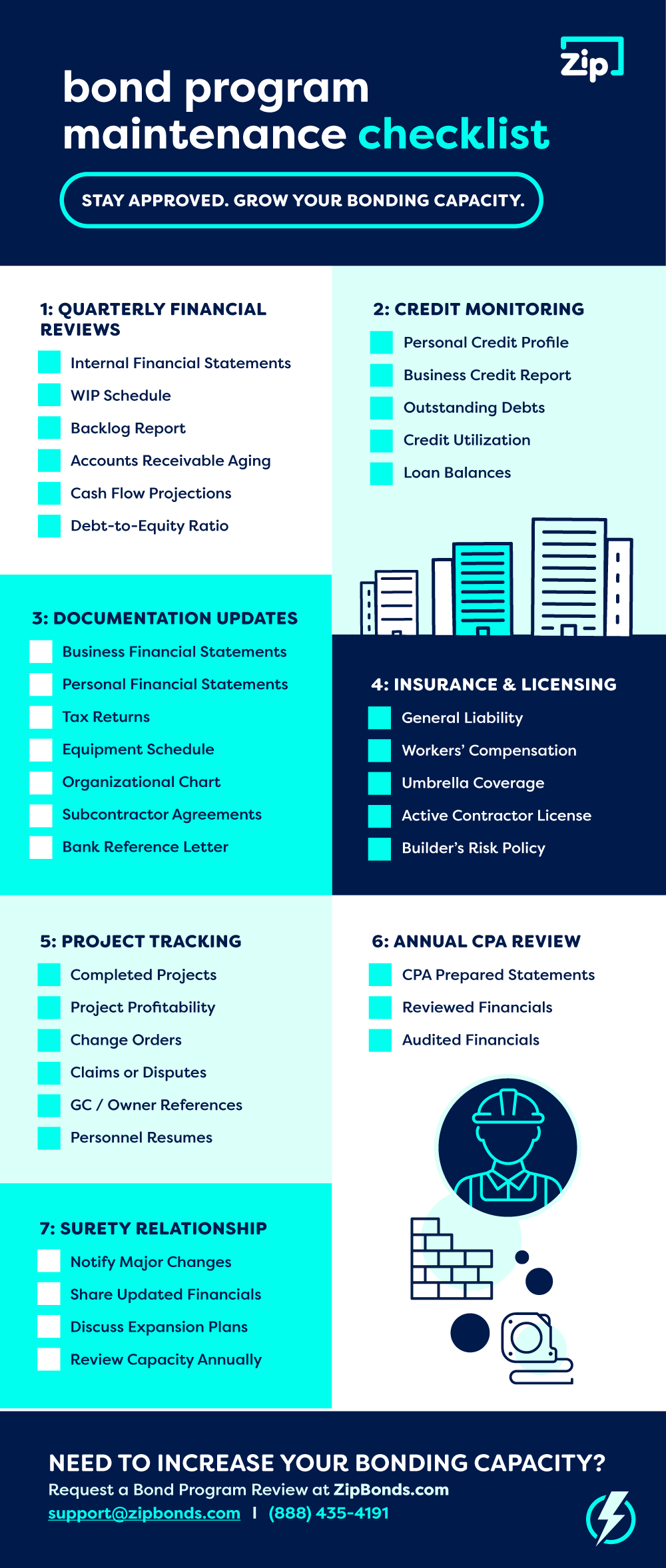
1. Quarterly Financial Reviews
Contractors should review:
- Updated internal financial statements
- Work-in-Progress (WIP) schedule
- Current backlog report
- Accounts receivable aging report
- Cash flow projections
- Debt-to-equity ratio
CPA-reviewed or CPA-prepared financial statements may be required annually for larger bond programs.
2. Credit Monitoring & Risk Management
Surety underwriting may consider:
- Personal credit profile of owners
- Business credit history
- Outstanding debts
- Credit utilization levels
- Loan or line-of-credit balances
Regularly monitoring credit can help prevent issues that may affect bonding eligibility or capacity increases.
3. Documentation Updates
Be sure to maintain updated:
- Business financial statements
- Personal financial statements (owners)
- Tax returns
- Organizational chart
- Equipment schedule
- Subcontractor agreements
- Bank reference letters
Providing updated documentation during underwriting reviews can help prevent delays when requesting additional bonding support.
4. Insurance & Licensing Compliance
Contractors should confirm that:
- General liability coverage remains active
- Workers’ compensation policies are current
- Umbrella or excess liability coverage is maintained
- Contractor licenses are renewed
- Builder’s risk policies are updated (if applicable)
Lapsed insurance or licensing may impact bond eligibility.
5. Project & Work History Tracking
Maintain internal records of:
- Completed projects
- Project profitability
- Change orders
- Project delays
- Claims or disputes
- Updated resumes for key personnel
- References from project owners or GCs
This information may be requested when applying for larger bonds or increasing bonding capacity.
6. Annual CPA Financial Review
Depending on program size, underwriters may require:
- CPA-prepared financial statements
- Reviewed financial statements
- Audited financial statements
Contractors pursuing larger public or commercial projects often benefit from upgrading internal financial reporting as their business grows.
7. Surety Relationship Management
To support long-term bonding growth:
- Notify your surety of major company changes
- Discuss expansion into new project types
- Communicate anticipated increases in backlog
- Share updated financials proactively
- Request bonding capacity reviews periodically
Maintaining open communication with your surety partner can improve underwriting support.
How This Impacts Your Bonding Capacity
Contractors who actively maintain their bond program may be better positioned to:
✔ Increase single job limits
✔ Improve aggregate program capacity
✔ Secure bonding for larger projects
✔ Qualify for better bond rates
✔ Reduce underwriting turnaround time
Download the Bond Program Maintenance Checklist
Want a printable checklist you can use throughout the year? Download the checklist to stay organized and maintain your bonding capacity over time.
Bond Program Maintenance Checklist PDF
Next Steps: Request a Bonding Capacity Review
If your company is growing or preparing to pursue larger bonded projects, ZipBonds can help you review your current bond program and explore capacity increases.
Request a Bond Program Review today by emailing support@zipbonds.com.